
Who Explains The Machines?
“Until yesterday, I had no idea PHP existed,” states the BBC’s cyber correspondent, on the day critical PHP flaws took chunks of the internet offline.
Periodical tech commentary from the in-between.
This week, the details of two critical security flaws in PHP leaked onto the web before an official patch was ready. The CVE identifiers appeared on Hacker News, a day before the planned disclosure. The PHP team moved its emergency release forward, as reports of the vulnerability being actively exploited started to circulate. Sites started going offline as a precautionary measure.
PHP is not obscure. Despite people pronouncing it to be dead for at least a decade (it's a running joke at this point), it still powers a large share of the web, as was proven by this incident.
In the aftermath, I was reading through a BBC live feed and came across this little ditty.
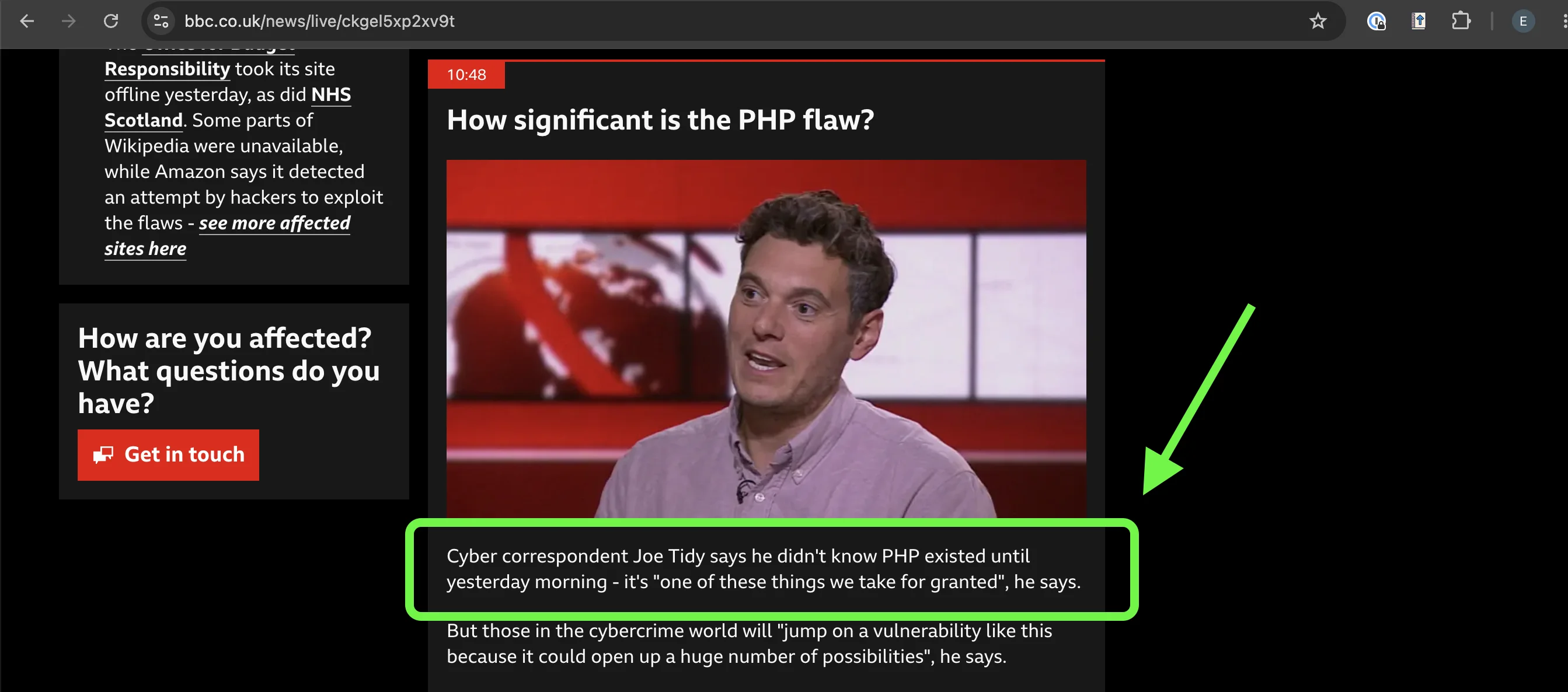
This is not a dig at one journalist. I am sure he is a nice chap, and has achieved more as a journalist and writer than I ever will. But it does serve as a stark reminder that widely trusted news organisations, and their correspondents, do not necessarily have domain-level expertise on matters in which they report.
The PHP line is a Gell-Mann Amnesia moment for anyone in tech. I noticed this, because I know what PHP is. If this had been an article on economics, or the climate, I probably would not have. But the specialists in those fields are probably rolling their eyes too.
This feels particularly pertinent regarding the current reporting on AI, where it seems to rapidly cycle between "AI will kill us all" and "AI is overhyped".
Tech reporting can move money, and affect how politicians and voters think. Remember the time an MIT report on AI failing moved the NASDAQ, or how reports of DeepSeek's cheap training costs wiped $600 billion of NVIDIA's value.
In both instances, investors seemed to react to the headline faster than anyone could check the detail. If the people writing these headlines can't objectively judge these claims, the gap between what they know and what they report can have both a literal and a metaphorical price tag.
So the next time a headline tells you AI is about to end the world, or that it's all a bubble, remember the PHP line...and that the person explaining it to you may only just have discovered the subject matter.